What Is a Good IQ Score by Age?
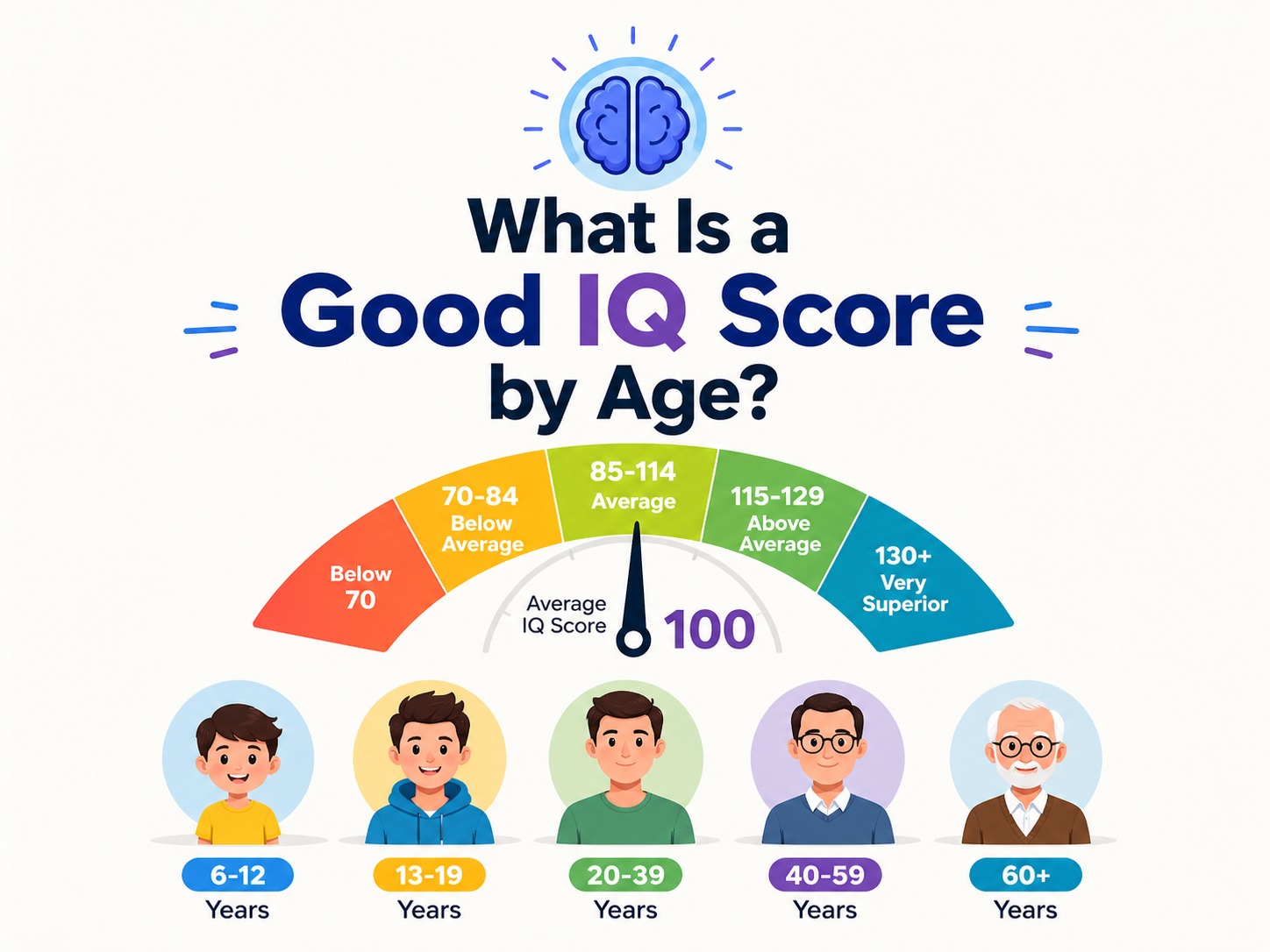
When people hear the term “IQ,” the first question that comes to mind is simple: what counts as a good score? The answer isn’t as straightforward as a single number. IQ, or Intelligence Quotient, is designed to measure cognitive abilities such as reasoning, problem-solving, and logical thinking—but it’s always interpreted relative to age. Understanding the IQ Scale IQ scores follow a standardized distribution where the average score is set at 100. Most people (about 68%) fall between 85 and 115, which is considered the normal or average range. Scores above or below this range indicate higher or lower cognitive performance compared to the general population. • 130+ → Very superior (gifted range) • 115–129 → Above average • 85–114 → Average • 70–84 → Below average • Below 70 → Extremely low But here’s the key insight: IQ tests are age-normalized, meaning your score is compared with others in your age group—not the entire population. IQ Scores by Age Group IQ tests are designed differently depending on age, ensuring fair comparison across developmental stages. Children (6–12 years): At this stage, IQ tests measure learning ability, memory, and pattern recognition. A “good” IQ score is still around 100, but even slight variations can indicate strong potential or areas needing support. Teenagers (13–19 years): Cognitive abilities become more stable during adolescence. A score of 110+ is often seen as above average, especially as reasoning and abstract thinking develop rapidly in these years. Adults (20+ years): IQ stabilizes in adulthood, and the same scale applies. A score between 90 and 110 is considered typical, while 120+ indicates strong analytical and problem-solving abilities. Does IQ Change With Age? Contrary to popular belief, IQ is relatively stable over time, especially after adolescence. However, certain cognitive abilities—like memory speed or processing speed—may decline slightly with age, while others like knowledge and experience often improve. This means your IQ score might not dramatically change, but how you use your intelligence certainly can. What Is Considered a “Good” IQ? A “good” IQ score depends on context. For academic success, a score slightly above average (110–120) is often sufficient. For highly demanding fields like advanced science or mathematics, higher scores (125+) may provide an advantage. However, IQ is not the only measure of intelligence. Skills like creativity, emotional intelligence (EQ), and practical decision-making also play a crucial role in real-world success. The Bigger Picture It’s important not to obsess over a single number. IQ tests measure specific types of intelligence, mainly logical and analytical thinking. They do not capture your full potential, talents, or abilities. In fact, many successful individuals fall within the average IQ range but excel due to discipline, curiosity, and consistent learning. Final Thought So, what is a good IQ score by age? In simple terms, anything around 100 is perfectly normal, and scores above that indicate stronger cognitive abilities relative to peers. But the real value lies not in the number itself—but in how you use your intelligence to learn, adapt, and grow.